
“A home gains soul when it is allowed to carry time, use, and the quiet evidence of a life being lived.” — NewMorning
Many homes are designed around the idea that beauty begins when every flaw has been removed.
Surfaces are expected to remain spotless. Furniture should look new. Rooms are styled until nothing appears accidental, personal, or unfinished. Yet the spaces we remember most often contain something less controlled: worn wood, soft linen, a handmade bowl, afternoon shadows, or an object that has become more meaningful through use.
Wabi-sabi interior design offers a gentler way of seeing a home. It values simplicity without emptiness, age without neglect, and imperfection without turning disorder into an aesthetic. It asks us to notice the beauty of materials, objects, and spaces as they change.
This does not require recreating a Japanese tea room or replacing everything you own with neutral furniture. It begins with attention: seeing what is already present, keeping what remains useful, and allowing the home to feel alive rather than permanently finished.
What Wabi-Sabi Really Means
Wabi-sabi cannot be reduced to a single decorating formula.
The Stanford Encyclopedia of Philosophy describes wabi as subdued, austere beauty and sabi as rustic patina—the beauty associated with age, tranquility, and the passage of time. These ideas developed within a wider Japanese aesthetic tradition shaped by impermanence and found powerful expression in poetry, architecture, and the culture of tea.
Wabi points toward modesty, restraint, and finding sufficiency without magnificence. Sabi recognizes the depth that time can give to a surface or object. Together, they encourage appreciation for things that are incomplete, changing, asymmetrical, or marked by use.
In a home, this might appear as:
- a wooden table whose grain has deepened with age;
- a hand-formed ceramic bowl with an irregular rim;
- linen that becomes softer after years of washing;
- a repaired object that still serves its purpose;
- an uncluttered wall where light and shadow become part of the room;
- a small collection chosen for meaning rather than perfection.
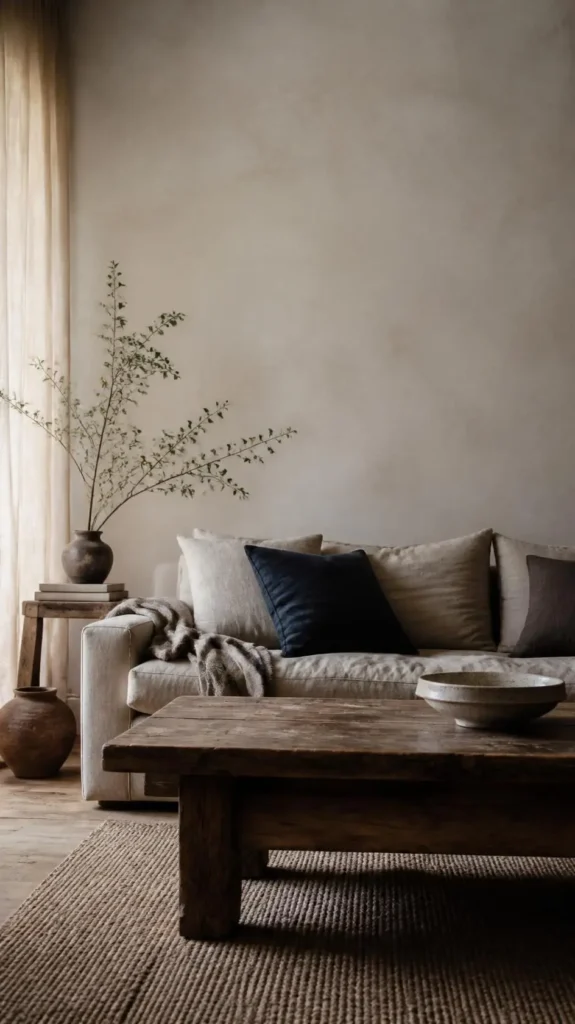
Wabi-sabi is less about achieving a recognizable look and more about changing the standards by which we decide that a home is beautiful.
Wabi-Sabi Is Not Simply Another Neutral Trend
Online images often translate wabi-sabi into beige plaster walls, low furniture, expensive stone, and carefully staged ceramics. These rooms may be visually beautiful, but the philosophy is broader than a particular palette.
A home does not become wabi-sabi because every object is brown, handmade, or intentionally distressed. Artificially damaging new furniture to make it appear old misses the point. So does purchasing a complete collection of “imperfect” decor at once.
The tradition is connected to real materials, moderation, age, use, and a willingness to see value where conventional ideas of luxury might not.
The Metropolitan Museum of Art’s discussion of Japanese tea culture describes how Sen no Rikyū favored austere settings and utensils that were often asymmetrical or imperfect. A surviving eighteenth-century tea caddy, for example, is valued for its restrained form and distinctive glaze rather than mechanical uniformity.
For the contemporary home, the lesson is not to imitate the object. It is to understand why its irregularity, usefulness, and material presence matter.
Begin With What Your Home Already Holds
The most authentic starting point is not shopping. It is looking.
Walk slowly through your home and notice what has already acquired character:
- a chair polished by years of use;
- a cutting board with visible knife marks;
- a faded book cover;
- a woven basket that has softened;
- inherited dishes that do not form a perfect set;
- a small scratch on a wooden surface;
- a handmade object with slight variations.
Ask whether these marks are damage that affects safety or function, or simply evidence of use. A loose chair leg should be repaired. Active mold, sharp edges, and unstable furniture should never be romanticized. But a softened finish or visible mending may not need to be hidden.
This shift can reduce the urge to replace things that are still useful. It also makes a home more personal because its beauty comes from a history no store can reproduce.
The approach connects naturally with The Cozy Home Mindset, where warmth is treated as a practice built through attention and daily life rather than a decorating project completed all at once.
Make Space Before Adding More
Wabi-sabi interiors often feel quiet, but quiet is not the same as empty.
The purpose of open space is to let materials, light, and useful objects be noticed. When every wall, table, and shelf is filled, even meaningful possessions can disappear into visual noise.
Begin by clearing one surface rather than decluttering the entire home. Remove everything from a bedside table, shelf, or console. Return only what is useful or personally significant. Leave some area unfilled.
The empty portion is not waiting for another purchase. It gives the remaining objects room to exist.
This does not require strict minimalism. Books, textiles, art, and family objects can all belong in a wabi-sabi home. The question is whether they support the room or merely prevent you from seeing it.
If you prefer warmth over starkness, Soft Minimal Home explores a similar balance between simplicity, texture, and the signs of everyday life.
Choose Materials That Change Gracefully
Natural materials are central to many wabi-sabi interiors because they reveal variation and respond visibly to time.
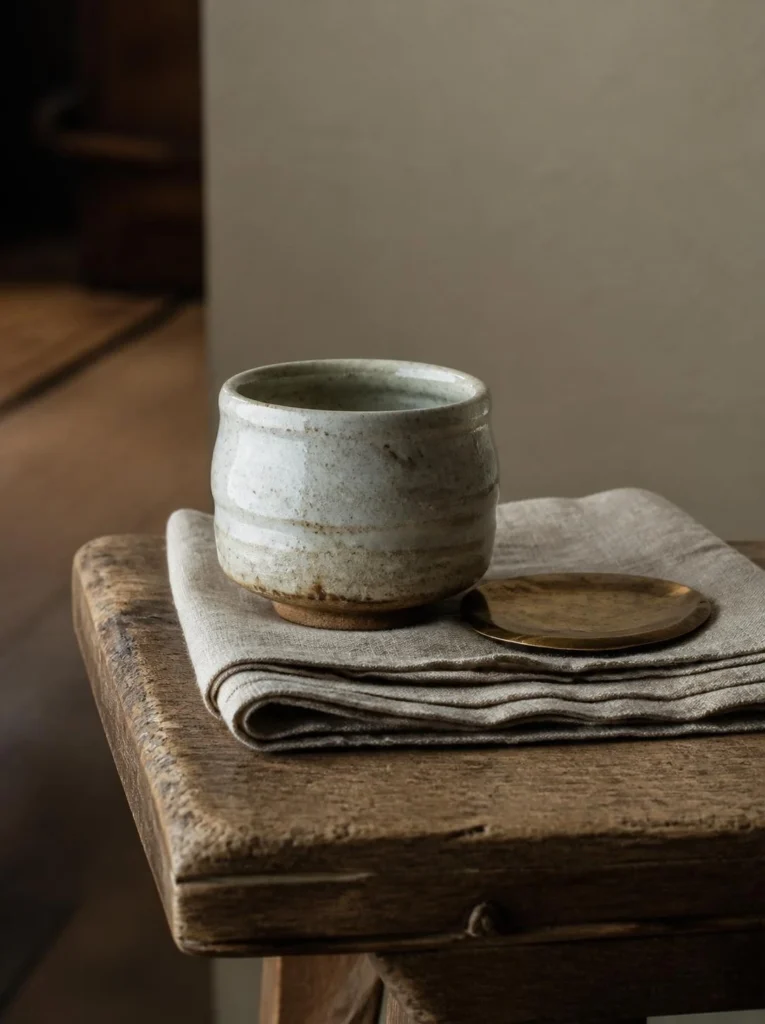
Wood develops deeper color, small dents, and polished areas where hands repeatedly touch it. Linen relaxes and creases. Uncoated metals develop patina. Stone carries veining, pores, and differences in tone. Clay records the pressure of hands, glaze, heat, and firing.
Consider:
- solid or reclaimed wood;
- linen, cotton, hemp, and wool;
- clay, stoneware, and earthenware;
- stone with a honed rather than mirror-polished surface;
- woven grasses or natural fibers;
- aged brass, bronze, copper, or blackened iron;
- paper, plaster, limewash, and other matte finishes.
Natural does not automatically mean practical, sustainable, or affordable. Choose materials that suit your climate, maintenance capacity, and actual use. A washable cotton cover may serve your household better than delicate linen. A durable existing laminate surface is more responsible than replacing it only to obtain a more “authentic” look.
Wabi-sabi asks for honesty, not purity.
Let Imperfection Remain Visible
Machine-perfect repetition can make a room feel distant. Slight irregularity gives the eye somewhere to rest.
A handmade bowl may sit unevenly. A vintage table may show a repaired corner. Plaster may reflect light differently across the wall. Floorboards may vary in tone. A textile may contain small changes in weave.
These qualities do not need to become the focal point of every room. Their effect is often quiet.
The Metropolitan Museum of Art’s Brown Oribe flower holder illustrates this beautifully. Its asymmetrical form and variations created during firing are not corrected or concealed; they record material, process, and the conditions of its making.
In an everyday home, visible imperfection can be simpler:
- keep the original grain of a wooden shelf;
- choose a handmade mug instead of a perfectly matched set;
- allow linen to remain naturally creased;
- retain a small, stable repair;
- frame a drawing with an irregular line;
- combine objects that relate without being identical.
The goal is not to collect flaws. It is to stop requiring sameness before something can feel beautiful.
Repair Before Replacing
Repair is one of the clearest ways a home can honor time and continued usefulness.
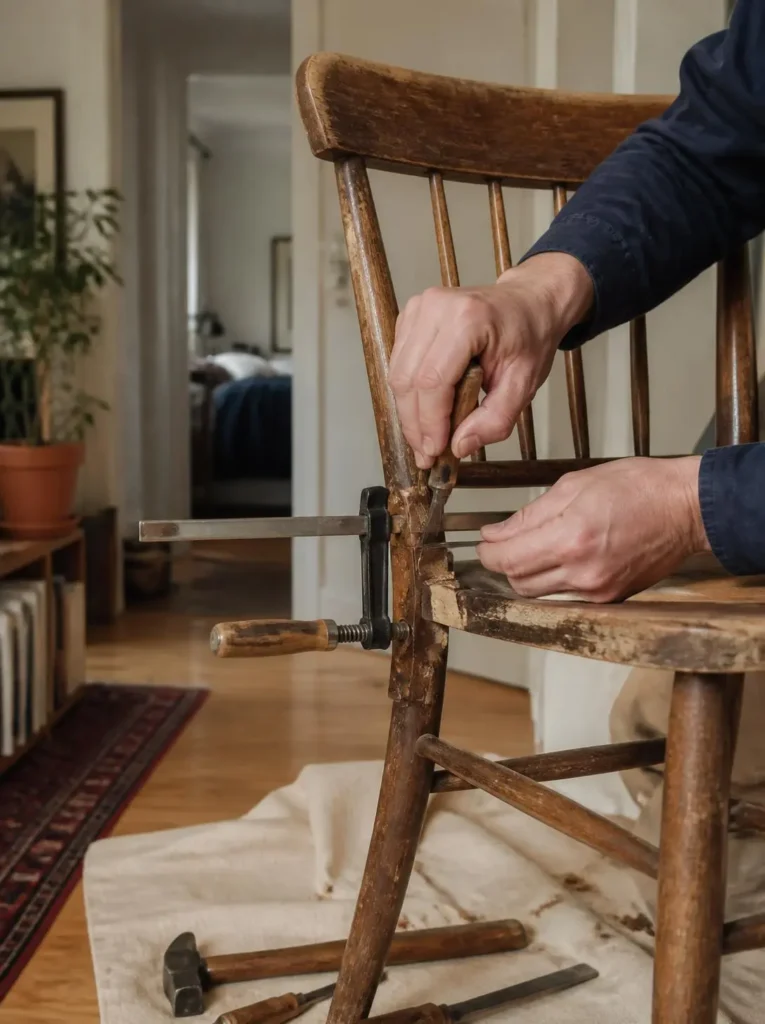
Tighten the chair. Mend the cushion cover. Refinish the dry wooden surface. Replace the lamp cord. Sew the missing button. Ask a skilled craftsperson whether an inherited piece can be stabilized.
The repair does not always need to disappear. A visible patch, contrasting stitch, or carefully joined piece can become part of the object’s history.
Japanese repair traditions such as kintsugi are often used as shorthand for wabi-sabi, but they should not be treated as a casual decorative effect. Not every broken plate should be repaired with imitation gold, and damaged foodware may no longer be safe for use unless restored with appropriate materials and expertise.
The deeper principle is more accessible: something does not lose all value because it has been damaged. Thoughtful care can give it another chapter.
Use an Earth-Inspired Palette Without Removing Color
Wabi-sabi rooms often draw from colors found in natural materials:
- warm white;
- clay;
- sand;
- mushroom;
- charcoal;
- faded indigo;
- weathered brown;
- moss or muted olive;
- rust;
- smoke gray.
These tones work because they contain subtle variation and allow texture to remain visible. Yet a wabi-sabi home does not need to become entirely neutral.
A worn blue cabinet, faded red textile, glazed green bowl, or dark wooden chest can bring depth. Color feels most grounded when it appears through material and use rather than as a perfectly matched scheme.
Start with the colors already present in your floors, furniture, books, and textiles. Repeat two or three of them gently across the room. Let variations remain instead of searching for exact matches.
A restrained palette should make your belongings easier to see—not erase their individuality.
llow Light and Shadow to Shape the Room
Wabi-sabi is especially sensitive to changing light.
A glossy room with uniform overhead illumination can flatten texture. Softer layers of light allow wood grain, plaster, linen, and irregular ceramics to appear gradually.
Use daylight where possible, but avoid trying to make every corner equally bright. In the evening, combine:
- one warm floor lamp;
- a small table lamp;
- a shaded pendant;
- reflected rather than exposed light;
- candles only where they can be used safely.
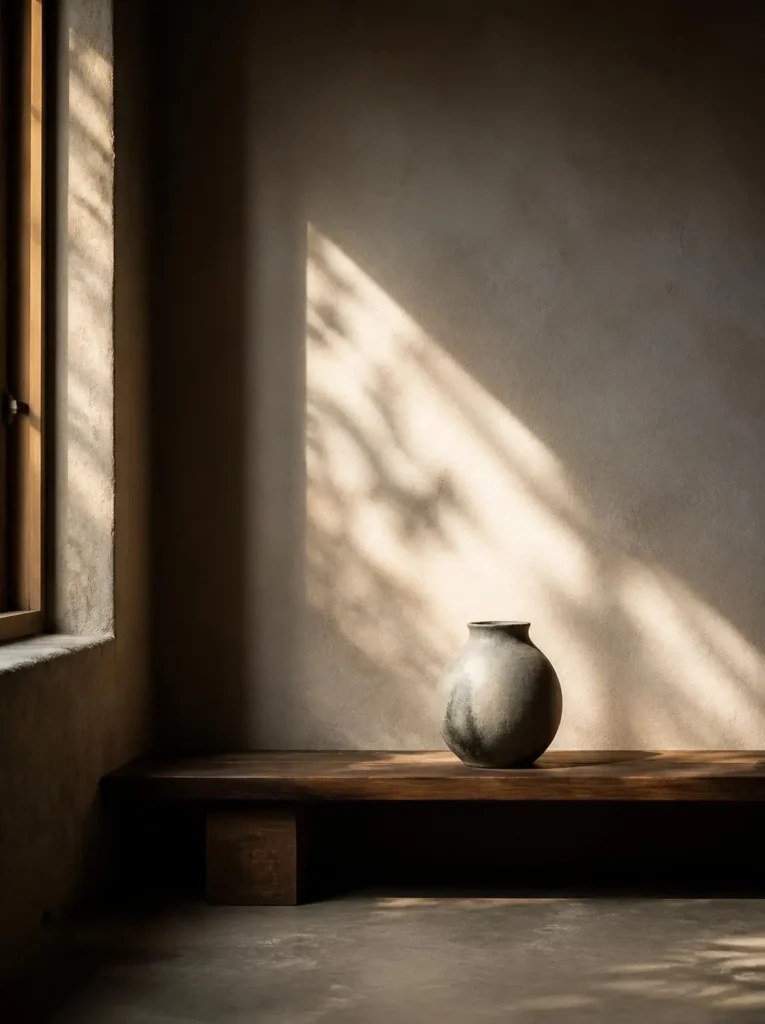
Notice what happens as the sun moves across a wall or table. A quiet patch of shadow can give a room depth without adding another object.
The Stanford overview of Japanese aesthetics discusses the importance of emptiness, light, and shadow in traditional architecture—not as absence, but as conditions that allow atmosphere to emerge.
The simplest adjustment may be replacing one harsh overhead routine with smaller, warmer pools of light.
Choose Fewer Pieces With Greater Presence
Wabi-sabi furniture tends to feel grounded and direct.
Look for simple forms, useful proportions, visible material, and construction that can age honestly. One sturdy wooden table may contribute more than several decorative pieces. A repaired vintage chair may carry more presence than a complete matching set.
You do not need to replace furniture that already works. Begin by giving the strongest pieces more space. Remove one unnecessary side table, relocate a chair that interrupts movement, or clear objects from a surface whose material deserves to be seen.
When adding something, consider:
- Will it be used regularly?
- Can it be repaired?
- Does the material improve with age?
- Is the scale appropriate for the room?
- Does it complement what is already here?
- Would I still value it if it stopped being fashionable?
A soulful home grows through discernment, not constant accumulation.
Bring in Handmade Objects Slowly
Handmade pieces naturally reveal process.
Finger marks in clay, slight differences in glaze, woven fibers, carved wood, and visible joins remind us that an object passed through someone’s hands. These variations can bring warmth to industrial or newly built rooms.
Choose one piece that serves a real purpose:
- a bowl used for fruit;
- a ceramic cup for a daily drink;
- a woven basket for blankets;
- a wooden tray;
- a hand-stitched cushion;
- a small original artwork;
- a vase used for garden branches.
The Smithsonian’s National Museum of Asian Art explains that Raku tea ceramics are formed by hand rather than on a wheel, and their distinctive forms developed in close relationship with the practice of tea. Their importance lies in the connection between material, maker, and use—not simply their uneven appearance.
Support local makers when possible, but do not assume handmade objects must be expensive. Family pieces, your own simple projects, secondhand craft, and useful items made by people in your community can carry equal meaning.
Create Asymmetry That Still Feels Balanced
Wabi-sabi does not depend on perfect pairs.
Instead of placing identical lamps, vases, or frames on both sides of a surface, try balancing unlike elements through visual weight. A tall lamp on one end of a console might be balanced by a lower stack of books and a broad bowl on the other.
On a shelf, combine a vertical row of books with one handmade object. On a dining table, place a simple branch slightly off-center. Above a bench, hang one piece of art rather than filling the entire wall.
Asymmetry feels calm when the room still has clear relationships:
- repeat a color;
- balance tall and low forms;
- leave breathing room;
- vary shapes without adding too many;
- step back and check where the eye settles.
The result should feel natural, not deliberately awkward.
Let Nature Enter in Modest Ways
Connection with nature does not require filling every shelf with plants.
A single branch, bowl of seasonal fruit, smooth stone, dried seed head, or view through an uncovered window may be enough. Choose elements that can change naturally rather than permanent arrangements designed to look untouched.
You might:
- display one fallen branch after a walk;
- bring herbs into the kitchen;
- place a seasonal flower in a simple bottle;
- keep curtains open to a tree or sky view;
- use a stone collected from a meaningful place;
- rotate natural objects rather than accumulating them.
Avoid collecting from protected environments or removing living material irresponsibly. The relationship should be attentive, not extractive.
As seasons change, allow the room to change subtly too. Wabi-sabi is rooted in impermanence, so a home does not need to maintain the same arrangement all year.
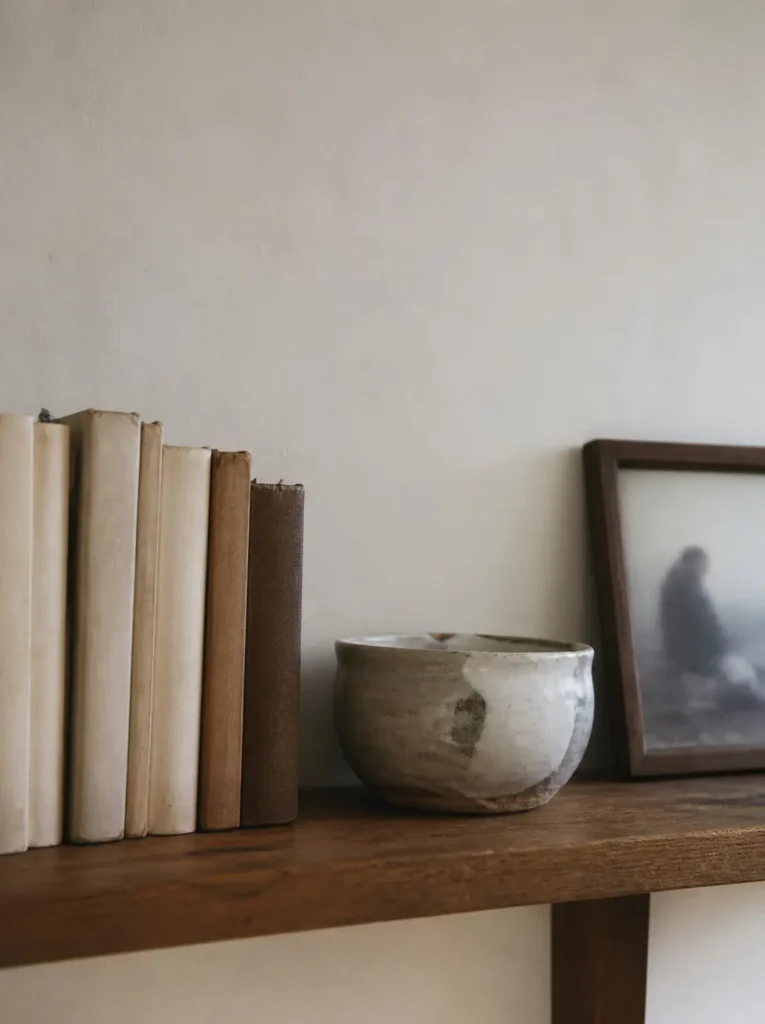
Style Shelves With Restraint and Meaning
A wabi-sabi shelf should feel more like a personal record than a product display.
Begin with books you read, objects you use, and pieces connected to memory. Mix a vertical row of books with a small ceramic object, an aged box, or a framed photograph. Leave open space between groupings.
Avoid buying blank books, artificial aging, or generic objects simply to reproduce a photograph.
Decorating With Books offers practical ideas for using real collections on shelves and tables while keeping them accessible. Its central principle fits wabi-sabi perfectly: the most beautiful display begins with what genuinely matters to you.
Dust, edit, and rearrange occasionally, but do not style the shelf until it loses its usefulness.
A Wabi-Sabi Approach to Each Room
Living room
Let one material lead: a wooden table, linen sofa, woven rug, or stone surface. Keep pathways open, use layered warm light, and choose a few objects with history.
Bedroom
Use breathable textiles, a calm but not perfectly matched palette, and minimal bedside objects. Allow washed linen to crease naturally and keep the room visually quiet.
Kitchen
Retain useful wooden boards, mismatched ceramics, and frequently used cookbooks. Repair what can be repaired and keep counters open enough for real work.
Bathroom
Choose tactile towels, a simple tray, aged metal, stone, or handmade soap dish. Prioritize ventilation and hygiene; wabi-sabi never means accepting mold or unsafe deterioration.
Home office
Use a durable desk, visible paper, one meaningful object, and clear space for concentration. Let tools remain accessible rather than disguising all evidence of work.
Entryway
Keep only what supports arrival: a sturdy bench, hook, bowl for keys, and perhaps one worn basket. Function creates its own quiet beauty.
How to Practice Wabi-Sabi in a Rental
You do not need to renovate.
Focus on removable and useful layers:
- linen or cotton curtains;
- a secondhand wooden side table;
- warm lamps;
- handmade or mismatched ceramics;
- woven baskets;
- an aged mirror;
- art printed on textured paper;
- natural-fiber cushion covers;
- a small arrangement of real books;
- repaired objects you already own.
Work with the apartment’s existing marks instead of treating every limitation as a problem to conceal. A slightly uneven wall, older floor, or simple cabinet can become part of the room’s character when the rest of the space is calm and intentional.
Always follow lease conditions and avoid changes that risk damage.
How to Begin Without Buying Anything
Try this one-afternoon reset:
Notice
Walk through the room and identify three surfaces or objects whose material you genuinely like.
Clear
Empty one surface and clean it gently.
Return
Put back only the objects that are useful, meaningful, or beautiful because of their history.
Repair
Choose one small item that needs mending, tightening, oiling, or another appropriate form of care.
Reposition
Move a lamp, chair, or table so that natural light, shadow, and movement through the room feel easier.
Finish
Bring in one seasonal element from what you already have: a branch, bowl of fruit, stack of books, or handmade object.
The room may look simpler, but the greater change is in how you see it.
Common Wabi-Sabi Decorating Mistakes
Treating it as a beige shopping list
A complete room purchased at once may imitate the surface but miss the philosophy of time, use, and moderation.
Confusing imperfection with neglect
Unsafe furniture, moisture, mold, broken wiring, sharp ceramics, and structural damage require attention.
Artificially distressing everything
Manufactured wear does not carry the same meaning as honest age or skilled handwork.
Removing all color and personality
Wabi-sabi is restrained, not anonymous. Books, art, textiles, and inherited objects can remain.
Copying Japanese symbols without context
A home does not need decorative calligraphy, shoji imitations, or tea objects to express appreciation for simplicity and impermanence.
Equating emptiness with discomfort
Rooms still need supportive seating, adequate lighting, storage, warmth, and the objects required for daily life.
Buying fragile natural materials unsuited to your home
Consider climate, pets, children, cleaning, accessibility, and maintenance before choosing a material.
A Gentle Wabi-Sabi Checklist
- Begin with what you already own.
- Keep useful objects in circulation.
- Repair before replacing when safe and practical.
- Choose materials that reveal texture and age.
- Leave open space around meaningful pieces.
- Accept small variations and asymmetry.
- Use warm, layered light.
- Bring nature indoors modestly.
- Avoid artificial distressing.
- Let the home change with your life.
- Choose comfort and function alongside beauty.
- Treat the cultural tradition with respect.
A wabi-sabi home is never truly finished. That is not a flaw in the process. It is the point.
Reader Reflection
What in your home has become more beautiful because you have lived with it?
Choose one object, material, or corner that carries time well. Give it space, care for it, and allow it to remind you that a meaningful home does not need to look new.
Frequently Asked Questions
What is wabi-sabi interior design?
Wabi-sabi interior design applies ideas of modesty, impermanence, natural change, and rustic patina to the home. It favors useful objects, authentic materials, quiet space, asymmetry, repair, and signs of age over flawless surfaces and constant newness.
Is wabi-sabi the same as minimalism?
No. Both can value simplicity and open space, but wabi-sabi places particular attention on impermanence, age, modesty, and imperfect natural materials. A wabi-sabi room may contain collections and personal objects when they carry meaning and use.
What colors are used in wabi-sabi interiors?
Common colors include warm white, sand, clay, mushroom, faded blue, moss, rust, charcoal, and weathered brown. However, wabi-sabi is not limited to neutrals; color can appear through natural materials, aged textiles, ceramics, books, and useful objects.
What materials work well in a wabi-sabi home?
Wood, linen, cotton, wool, clay, stone, paper, plaster, woven fibers, and metals that develop patina are common choices. Existing durable materials should not be discarded merely because they are synthetic or visually imperfect.
Can wabi-sabi work in a modern apartment?
Yes. Use warm lighting, natural or tactile textiles, a few handmade objects, visible books, secondhand furniture, open space, and repairs. The philosophy does not require traditional Japanese architecture.
Does wabi-sabi mean keeping damaged objects?
Only when the object remains safe, stable, useful, or can be properly repaired. Mold, electrical faults, structural damage, sharp edges, and unsafe foodware should be addressed rather than romanticized.
Is Japandi the same as wabi-sabi?
No. Japandi is a contemporary interior style combining Japanese and Scandinavian influences. Wabi-sabi is a much older Japanese aesthetic perspective concerned with modest beauty, impermanence, incompleteness, and patina. Japandi interiors may borrow from wabi-sabi, but the terms are not interchangeable.
How can I add wabi-sabi without buying anything?
Clear one surface, reveal the texture of existing furniture, repair a useful object, rearrange lighting, display meaningful books, and allow a naturally aged piece to remain visible. Attention and editing matter more than purchasing.
Continue the Journey
Soft Minimal Home: Explore how simplicity becomes warmer when a home leaves room for texture, comfort, and the evidence of daily life.
Warm Minimalism: How to Create a Calm Home That Still Feels Lived In: Discover a contemporary balance of clean space, natural materials, layered warmth, and personal objects.
The Art of a Cozy Home: Consider how rituals, memory, and meaningful details shape a home more deeply than decoration alone.
Decorating With Books: 12 Cozy Ways to Make Your Home Feel Personal: Use the books you genuinely love to bring history, color, and personality into shelves, tables, and small spaces.