“A more analog life begins when the things we can touch, make, remember, and share are given room to matter again.”
Much of modern life happens through a screen before we have consciously chosen it.
We wake to a phone alarm, check the weather in an app, read digital messages over breakfast, follow directions from a map, work on a computer, stream music while cooking, and reach for online entertainment when the day is finished. Technology moves so smoothly through these moments that it can become difficult to notice where one digital task ends and another begins.
An analog lifestyle creates a little contrast.
It brings paper back to the desk, books back into the evening, conversations back to the table, and activities that use the hands back into leisure. It does not attempt to recreate another decade or remove every useful device. It simply makes room for experiences that feel physical, finite, and fully present.
The goal is not to live without technology.
The goal is to remember that life also exists beyond it.
What Is an Analog Lifestyle?
An analog lifestyle is an intentional way of including more physical, screen-free, and hands-on experiences in everyday life.
It may include:
- reading printed books and magazines;
- writing plans or reflections on paper;
- listening to an album without browsing another app;
- cooking from a printed recipe;
- using an analog alarm clock;
- taking photographs more selectively;
- making something by hand;
- spending time with other people without a phone on the table;
- allowing some errands, walks, and pauses to remain offline.
The idea gained wider attention in 2026 as people began turning toward physical media, craft nights, letter writing, simple phones, and other alternatives to constant digital access. A University of California, Riverside feature on the analog lifestyle described it as something different from a temporary digital detox: a longer-term effort to slow down and bring tangible ways of thinking, creating, and finding entertainment back into daily life.
There is no requirement to replace every digital tool with an older version.
Analog living is less about the age of an object and more about the quality of attention it invites. A notebook asks you to remain with one page. A physical book has a beginning and an ending. A puzzle waits without sending a notification. A conversation unfolds without an algorithm choosing what should appear next.
Why Analog Living Feels Relevant Now
Digital life offers extraordinary convenience. It also removes many of the natural stopping points that once shaped an ordinary day.
A newspaper ended. A roll of film had a limited number of photographs. A record required choosing an album and turning it over. A shop closed for the evening. A letter could not be refreshed while waiting for a reply.
Many digital experiences are designed differently. Feeds continue, recommendations multiply, and an entire library of entertainment remains available at every hour. The abundance is useful, but it can make rest feel strangely unfinished.
This may help explain why physical hobbies and media are returning. People are not necessarily rejecting progress. They are looking for experiences with edges: something that can be held, completed, repaired, passed to another person, or placed back on a shelf.

Research also suggests that changing access to the online world can change how people spend their time. In a 2025 randomized controlled trial published in PNAS Nexus, blocking mobile internet on smartphones for two weeks improved participants’ sustained attention, mental health, and subjective well-being. Participants spent more time socializing in person, exercising, and being in nature, while calls, text messages, and computer access remained available.
An analog lifestyle does not reproduce this experiment. It offers a softer everyday question: What might return if the screen were not always the easiest option?
Analog Does Not Mean Anti-Technology
It is easy to imagine analog living as an all-or-nothing choice.
Either you use modern technology or you become someone who writes every letter by hand, owns a landline, listens only to vinyl, and never carries a smartphone.
Real life is more flexible.
Technology helps us work, navigate unfamiliar places, communicate across distance, access education, manage money, and find communities that may not exist nearby. Rejecting those benefits is not necessary.
An analog lifestyle asks technology to return to the role of a tool.
You might use an app to discover a knitting pattern, then close the laptop and work with your hands. You might message a friend to arrange dinner, then keep the phones away from the table. You might find a book online, borrow the printed copy from the library, and read it without notifications nearby.
This is also the distinction at the heart of Digital Slow Living: intentional technology use is not the same as permanent disconnection.
The digital world can help you enter an experience. It does not need to remain at the center of it.
Begin With One Part of the Day
Trying to transform your entire lifestyle at once can turn a peaceful idea into another demanding project.
Begin with one part of the day that already feels too digital:
- the first thirty minutes after waking;
- breakfast or morning coffee;
- the commute;
- the lunch break;
- the hour after work;
- dinner;
- the final part of the evening;
- a quiet weekend morning.
Then choose one physical alternative.
Place an alarm clock beside the bed so the phone can charge elsewhere. Keep a paperback near the chair where evening scrolling begins. Write tomorrow’s priorities on a small card before closing the laptop. Carry a crossword for the train. Bring a printed recipe into the kitchen.
Stanford Lifestyle Medicine recommends small, purposeful screen-time changes such as creating phone-free spaces, taking regular breaks, and replacing unnecessary digital use with reading, time outdoors, or time with other people.
The most sustainable starting point is rarely the most dramatic one. It is the moment you can change without making the rest of your life harder.
Bring Paper Back Into Everyday Life
Paper slows information down.
A notebook cannot hold every possible idea at once. A paper calendar reveals the shape of a week without opening messages, weather updates, or unfinished tasks. A handwritten list keeps one purpose in front of you.
You might use paper for:
- a short daily plan;
- a grocery list;
- morning pages;
- a reading log;
- recipes you return to often;
- meaningful addresses and birthdays;
- sketches and observations;
- a commonplace book;
- letters and postcards;
- a list of places you would like to visit;
- a record of ordinary moments you want to remember.
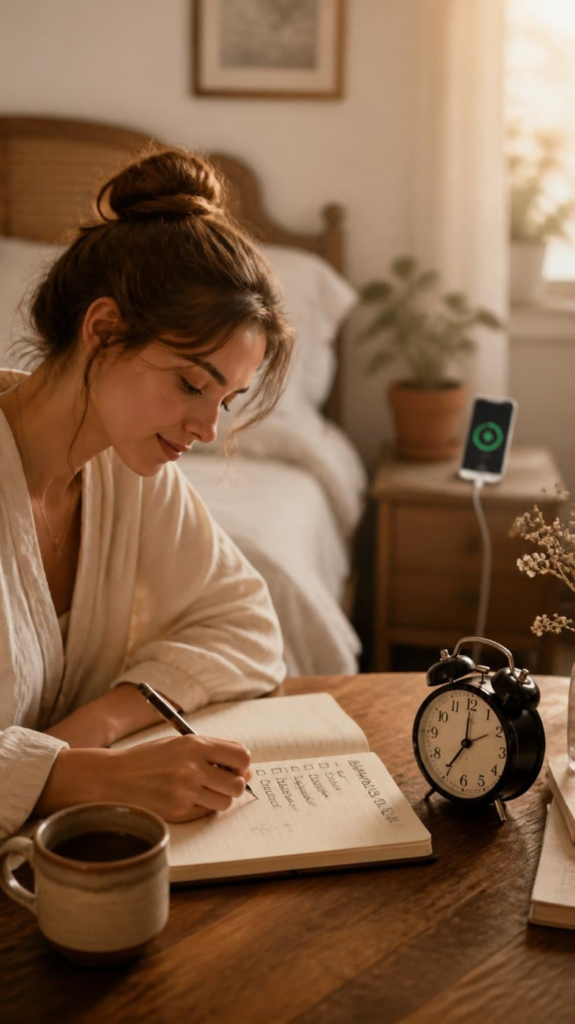
The point is not that handwriting is always better than typing. Digital notes are searchable, portable, and easy to organize. Paper simply offers a different kind of space—one without tabs, alerts, or the temptation to move immediately to something else.
Choose one use for paper rather than building an elaborate planning system.
A small notebook that lives in your everyday bag may be more valuable than a perfect collection of journals waiting to be used.
Choose Physical Media and Finite Entertainment
Digital entertainment often removes the effort of choosing. One episode leads to the next. A playlist continues after the final song. Recommendations appear before we have decided whether we want more.
Physical media brings selection back into the experience.
You can choose one album and listen from beginning to end. Borrow a DVD for a planned movie night. Read a printed magazine slowly over several mornings. Visit a library shelf without knowing exactly what you will find.
Consider adding one finite form of entertainment to your week:
- a printed book;
- a magazine or newspaper;
- a vinyl record or CD you already own;
- a borrowed film;
- a deck of cards;
- a board game;
- a jigsaw puzzle;
- a printed photography book;
- a radio program enjoyed without another screen nearby.
Physical media does not need to replace streaming or digital books completely. Its value lies in changing the rhythm.
There is something calming about choosing one thing and allowing it to be enough.
For a reading-centered version of this practice, Books and Peaceful Living explores how books can create depth and quiet within an ordinary day.
Make Something With Your Hands
Analog living becomes more meaningful when it involves creation rather than nostalgia alone.
Hands-on activities give attention a place to settle. They also leave evidence of time: a loaf cooling on the counter, several knitted rows, a page of handwriting, soil beneath the fingernails, or a repaired seam.
Interest in these activities is growing. The Michaels 2026 Creativity Trend Report identifies a wider shift toward creative living and tactile hobbies. The company reported increasing interest in activities such as knitting, journaling, painting, embroidery, and other forms of making.
Your analog practice might be:
- baking bread;
- knitting or crochet;
- gardening;
- drawing;
- simple watercolor;
- journaling;
- sewing or visible mending;
- pottery;
- flower arranging;
- woodworking;
- pressing leaves or flowers;
- making a scrapbook from real photographs and paper keepsakes.
Choose an activity because the process feels satisfying, not because the result would look beautiful online.
Our guide to Slow Hobbies can help you find a peaceful activity that fits the time, space, and energy you actually have.
Create a Home That Invites Offline Life
The objects that remain visible often shape what we do without requiring a decision.
When the television faces every seat and the phone follows us from room to room, digital entertainment becomes the natural center of rest. A few thoughtful changes can make offline activities just as available.
Try:
- placing a book on the coffee table;
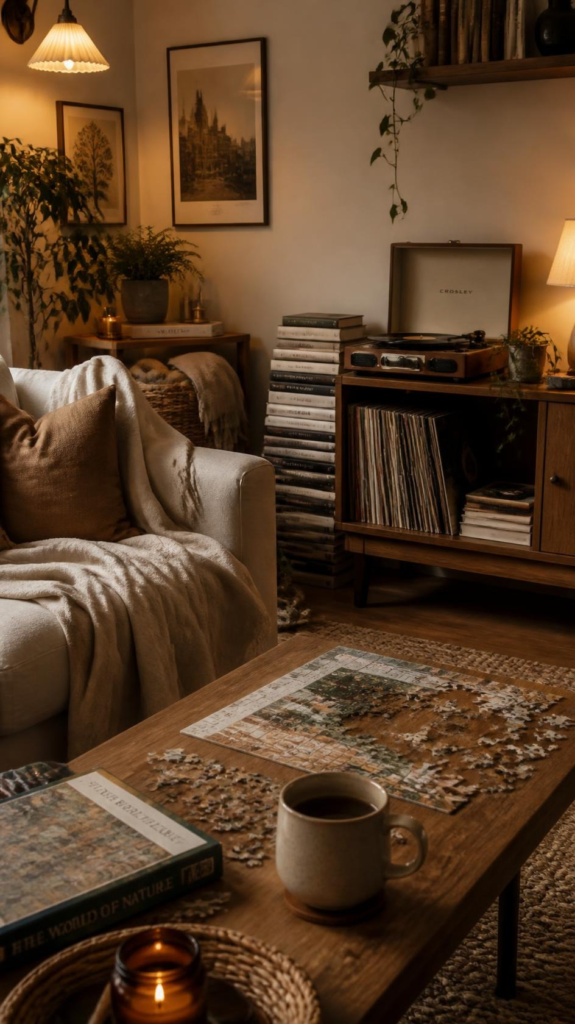
- keeping a puzzle where it can remain unfinished;
- giving the phone a charging place away from the sofa;
- leaving art materials in an easy-to-reach basket;
- creating a small table for cards, writing, or crafts;
- storing board games where they can be seen;
- keeping a blanket and reading lamp beside a comfortable chair;
- placing a radio or record player in a shared room;
- using an analog clock in the bedroom;
- making one dining surface easy to clear for conversation or projects.
You do not need a dedicated analog room. Begin with one corner that invites a different use of time.
The principles of Warm Minimalism are helpful here: allow meaningful materials, warm light, useful objects, and breathing room to work together without making the home feel empty.
Protect In-Person Connection
An analog lifestyle is not only about objects.
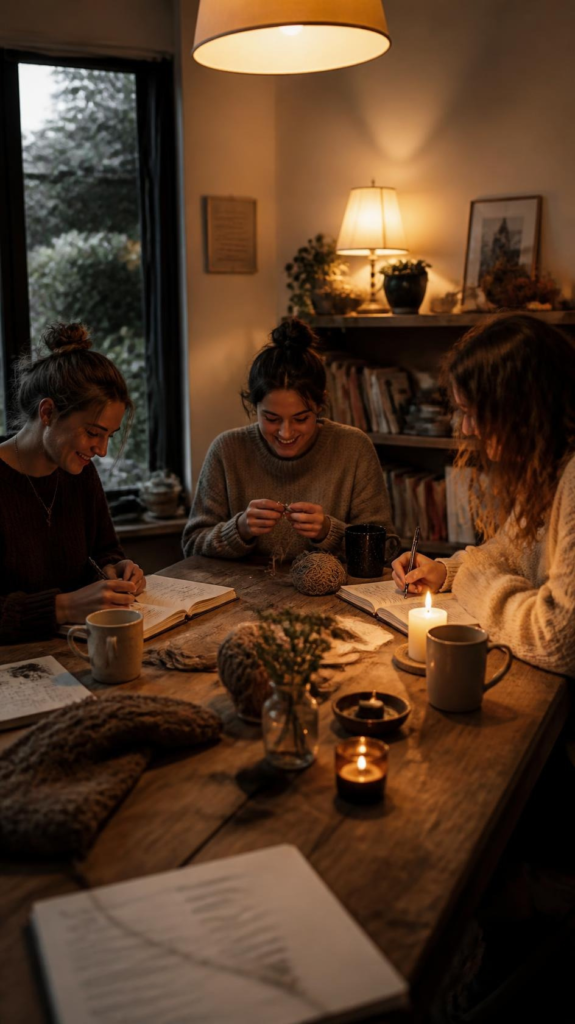
Some of its most meaningful moments happen between people: a long dinner, a walk without headphones, a craft night, a handwritten birthday card, a game played around a table, or a conversation allowed to move slowly.
Create gatherings that do not require constant documentation:
- invite one friend for coffee at home;
- cook a simple meal together;
- visit a library or secondhand bookshop;
- begin a puzzle that can stay on the table;
- organize a quiet reading hour;
- host a small craft evening;
- exchange postcards;
- take a walk and leave the phones inside a bag;
- listen to one album together;
- begin a monthly board-game night.
Phones do not need to be banned. They can simply become less central.
Use them to coordinate, photograph one meaningful moment if you wish, or look up something useful. Then let the gathering return to the people inside it.
Let Some Moments Remain Unrecorded
Digital life encourages us to capture, store, share, and organize experience.
Photographs can protect precious memories. Messages keep distant relationships alive. A saved map or note can bring us back to a place we loved.
But not every moment needs to become content or documentation.
Try walking without photographing the sky. Cook a meal without arranging it for a camera. Finish a book without immediately rating it. Visit a café without checking whether it is aesthetically worthy of sharing.
At first, an unrecorded moment may feel as though it will disappear.
Yet memory is not only a digital archive. It is also the warmth of a cup in your hands, the sound of another person laughing, the color of late light on a wall, and the feeling of having been somewhere without dividing your attention between living and documenting it.
Let a few experiences belong only to the day in which they happened.
Avoid Turning Analog Living Into Another Shopping Trend
The analog lifestyle can quickly become a list of objects to buy: a record player, film camera, typewriter, premium stationery, vintage telephone, special alarm clock, and carefully coordinated craft supplies.
These items may be useful or enjoyable. They are not the lifestyle itself.
Before purchasing something new, ask:
- What digital habit would this replace?
- Do I already own something that serves the same purpose?
- Am I interested in the activity or mainly in its appearance?
- Will I use this regularly after the novelty passes?
- Can I borrow, repair, or buy it secondhand?
Begin with what is already present.
Use the unread book, the forgotten deck of cards, the notebook with empty pages, the family recipe written on paper, or the half-finished project waiting in a drawer.
The Analog Bag is one practical way to gather these existing activities and keep them close enough to compete with the convenience of a phone.
Analog living should reduce noise and consumption, not introduce a new form of pressure.
Build an Analog Rhythm You Can Keep
A sustainable analog lifestyle will probably look ordinary.
It may be a paper list beside the coffee maker. A novel read for fifteen minutes before bed. A Sunday afternoon spent cooking without a phone in the kitchen. A monthly craft night. A walk taken without headphones. A basket that holds puzzles and writing materials beside the sofa.
Choose three simple anchors:
- One analog beginning — journal, stretch, make coffee, or open the curtains before checking the phone.
- One analog pause — read, walk, sketch, or sit outside during a break.
- One analog ending — put the phone away and close the day with music, conversation, a book, or a small hobby.
Allow technology to remain useful between those anchors.
There will be busy days when every plan happens through a screen. There will be evenings when streaming a familiar show is exactly the rest you need. Analog living is not measured by purity.
It is measured by whether the physical world still receives your attention.
A slower life is rarely built through one dramatic decision. It is built through small returns: to paper, to making, to shared tables, to books with final pages, to rooms where devices can rest, and to moments that do not need to become anything else.
The digital world will still be there when you return.
The purpose of analog living is to make sure the rest of your life is there too.
Frequently Asked Questions About the Analog Lifestyle
What is an analog lifestyle?
An analog lifestyle intentionally includes more physical, hands-on, and screen-free experiences in everyday life. It can involve printed books, paper planning, physical media, slow hobbies, in-person gatherings, and spaces where technology is less central.
Do I need to stop using my smartphone?
No. Analog living is not necessarily anti-technology. The goal is to use digital tools with intention while creating parts of the day where physical experiences, focused attention, and offline connection can take priority.
How can I start living more offline?
Choose one part of the day that feels overly digital and add a simple physical alternative. Read a printed book before bed, write your morning plan on paper, take a phone-free walk, or keep a puzzle or hobby beside the sofa.
Is an analog lifestyle expensive?
It does not need to be. Begin with objects and activities you already own, borrow books and media from the library, repair unfinished projects, and look for secondhand materials before purchasing something new.
What are simple analog activities?
Reading, journaling, walking, gardening, cooking, knitting, drawing, puzzles, board games, letter writing, listening to an album, and sharing an uninterrupted meal are all simple analog activities.
Continue the Journey
- Digital Slow Living: How to Reduce Screen Time Without Disconnecting Completely — Create thoughtful boundaries around technology while keeping the tools that genuinely support your life.
- The Analog Bag: A Simple Kit for Spending Less Time on Your Phone — Keep books, puzzles, and creative projects within reach when you want an inviting alternative to scrolling.
- Slow Hobbies: Peaceful Ways to Spend Less Time Online — Discover tactile activities that restore attention without turning leisure into another performance.
- Books and Peaceful Living — Explore how reading can add depth, comfort, and a quieter rhythm to everyday life.
- Simple Living Moments: Finding Joy in Ordinary Days — Return to the small experiences that make an ordinary day feel present and meaningful.