
“Sometimes spending less time online begins by placing something more inviting within reach.”
The instinct to reach for a phone rarely begins with a clear decision.
It happens in the quiet spaces between other things: while waiting for coffee, sitting in a parked car, resting on the sofa, or arriving a few minutes early. The phone is nearby, familiar, and filled with endless options. Before we notice, a small pause has become another scroll.
An analog bag offers a simple alternative.
It is a tote, basket, pouch, or small case filled with screen-free activities you genuinely enjoy. A paperback. A crossword book. A journal and pen. A small knitting project. A deck of cards. Anything that gives your hands and attention somewhere else to go.
The idea is not to reject technology or fill every free moment with a productive task. It is to make offline life easier to choose.
What Is an Analog Bag?
An analog bag is a portable collection of non-digital activities you can reach for instead of your phone. It may travel with you, remain beside your favorite chair, or wait near the door for quiet afternoons away from home.
The trend became especially visible in 2026, when people began sharing bags filled with novels, journals, puzzles, knitting, sketchbooks, and other tactile activities. The Guardian described the analog bag as part of a wider return to physical media and hands-on hobbies in response to screen fatigue.
Despite its name, there is no special bag to buy and no official list of contents.
The most useful analog bag is simply the one that contains something you will actually choose. For one person, that may be a mystery novel and a pencil. For another, it may be crochet, watercolor, or a half-finished letter.
What matters is not how the bag looks. What matters is that it makes another kind of attention available.
Why the Analog Bag Is More Than an Internet Trend
Trends often invite us to purchase a new version of something we already own. The analog bag can do the opposite.
Its real value is environmental. Your phone is easy to reach, so scrolling becomes easy to repeat. A book stored on a distant shelf or art supplies hidden in a drawer require more effort at the exact moment your energy is lowest. Placing an enjoyable offline activity in one visible, portable place changes the choice in front of you.
This does not mean every minute away from a phone will transform your well-being. It means you are creating small periods in which constant mobile access is no longer the default.
A 2025 randomized controlled trial published in PNAS Nexus found that blocking mobile internet on smartphones for two weeks improved participants’ sustained attention, mental health, and subjective well-being. Participants could still make calls, send texts, and use the internet on computers. The experiment changed access rather than demanding complete disconnection.
An analog bag works on a much smaller scale, but the principle is similar: it creates a little distance from the online world while leaving technology available when it is genuinely useful.
Replace the Scroll Instead of Leaving an Empty Space
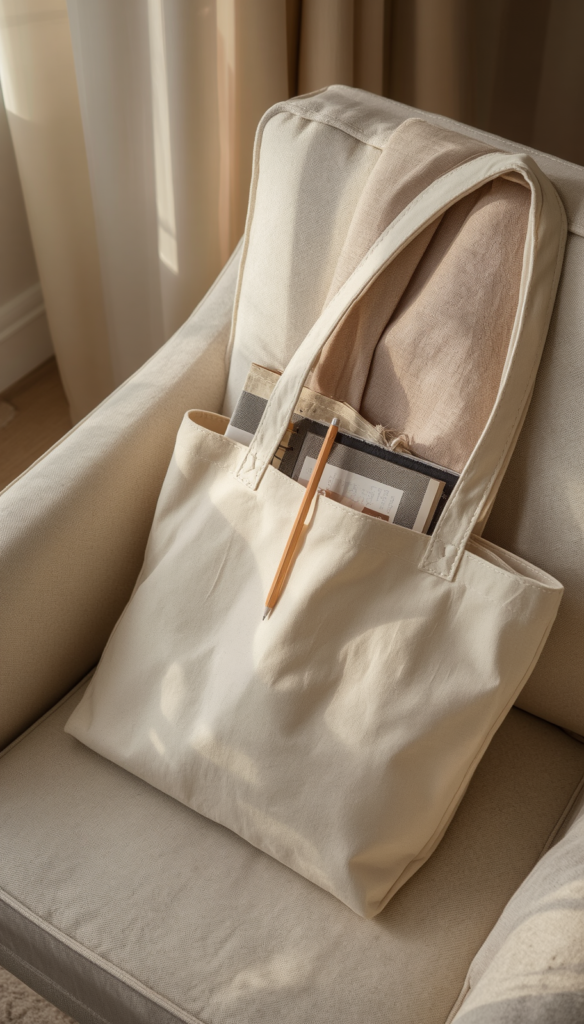
Telling yourself not to use your phone creates an empty space. If nothing appealing is ready to fill it, the familiar habit usually returns.
This is why an analog bag should not feel like a collection of worthy tasks. It should hold options that are genuinely pleasant.
Stanford Lifestyle Medicine’s guide to reducing screen time recommends small, purposeful changes such as creating phone-free places, taking regular breaks, and replacing unnecessary screen use with reading, time outdoors, or connection with other people.
The replacement matters.
If you scroll because you want a story, pack a novel or magazine.
If you scroll because your hands need something to do, try knitting, doodling, origami, or a pocket puzzle.
If you scroll because your mind feels crowded, include a journal.
If you scroll because you are bored while waiting, carry something that can be started and stopped easily.
The goal is not to become more disciplined. It is to make the gentler choice more convenient.
If you are also changing the way technology enters your day, begin with our guide to Digital Slow Living.
Start With a Bag You Already Own
Before shopping, look around your home.
A canvas tote, zippered pouch, small backpack, basket, or roomy handbag can become an analog bag. At home, you may not need a bag at all. A shallow basket beside the sofa can hold everything you need for a screen-free evening.
Choose a container that fits the way you intend to use it:
- a lightweight tote for errands and appointments;
- a small pouch that slips inside your everyday bag;
- a basket for evenings at home;
- a backpack for the park, library, or train;
- a project bag for knitting, crochet, or embroidery.
Then walk through the rooms where unfinished interests already live.
Look for the book you meant to begin, the notebook with only three pages used, the puzzle book in a drawer, the colored pencils left from another season, or the small craft project waiting in a cupboard.
Real Simple’s guide to creating an analog bag makes the same useful point: many of the materials are likely already at home, and the bag works best when its contents remain easy to carry and enjoyable to use.
Begin with what you own. The habit is the useful part—not the purchase.
Choose One Slow Hobby You Truly Enjoy
Start with one activity that can hold your attention without making you feel responsible for a result.
Good options include:
- knitting or crochet;
- embroidery or visible mending;
- sketching;
- simple watercolor;
- origami;
- hand lettering;
- a small puzzle;
- birdwatching notes;
- pressed-flower collecting;
- writing postcards or letters.
Choose something small enough to begin without setting up an entire workspace. A project that requires twenty supplies, a large table, or an online tutorial every few minutes may be better kept at home.
The best analog bag activity is not necessarily the most beautiful one. It is the one you will reach for when you have ten quiet minutes.
If you are still discovering what feels natural, Slow Hobbies offers peaceful ideas for spending less time online without turning leisure into another performance.
Add Something to Read
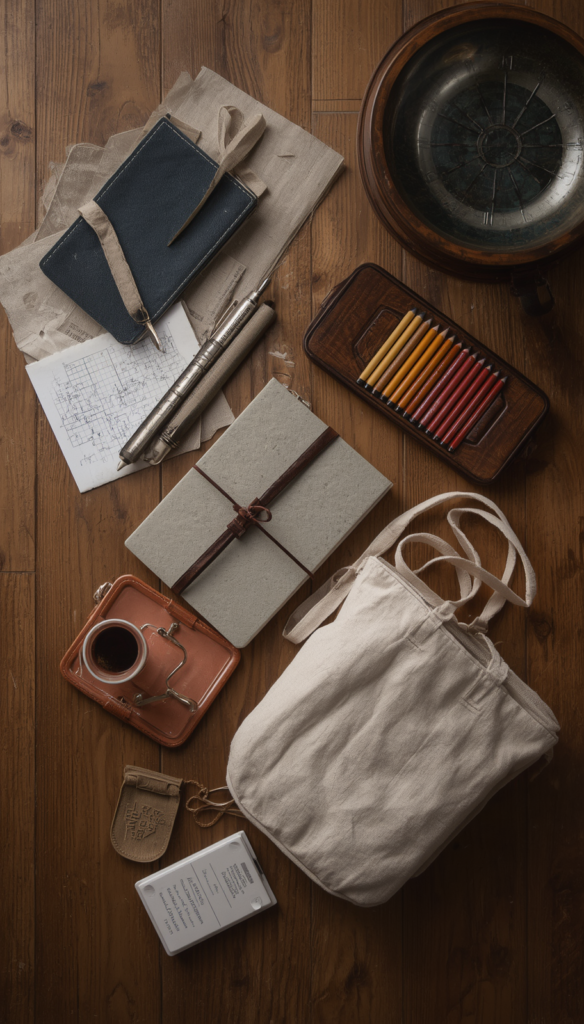
A physical book gives your attention somewhere deeper to rest.
Choose one that suits the moments when you will carry the bag. A dense nonfiction book may be perfect for a quiet afternoon at home but difficult to enter during a short wait. A collection of essays, poetry, short stories, or a light novel can be easier to open for a few pages and close without losing the thread.
You might include:
- a paperback already in progress;
- a print magazine;
- a small poetry collection;
- a book of essays;
- a locally printed newspaper;
- a pocket field guide;
- a collection of short stories.
Do not pack the book you think you should read. Pack the one you want to open.
Reading works especially well in an analog bag because it replaces the fragments of a feed with a single voice, subject, or story. It slows the movement of attention without leaving the mind empty.
Our reflection on Books and Peaceful Living explores how reading can become part of a calmer everyday rhythm.
Keep a Small Activity for Waiting
Some analog activities need time to settle into. Others can meet you in the small pauses that usually disappear into a phone.
For appointments, commutes, or early arrivals, include something easy to begin:
- a crossword or Sudoku book;
- a deck of cards;
- a pocket-sized logic puzzle;
- a word-search book;
- a travel chess set;
- a small notebook for observations;
- a few postcards and stamps;
- a printed list of things you would like to notice, draw, or write about.
These activities are not valuable because they make waiting productive. They are valuable because they allow a pause to remain a pause while still giving restless hands somewhere to go.
You may complete half a puzzle, write two sentences, or simply carry the bag without opening it.
That still counts. The analog bag is an invitation, not an assignment.
Include a Simple Creative Practice
Creativity becomes easier when the first step is already prepared.
A blank sketchbook alone may feel too open. A small card with three drawing prompts can help. A watercolor kit may remain unused if it needs several containers, but a water brush and a few colors can make beginning simple. A journal may feel demanding until you place one gentle question inside its cover.
Try adding:
- a pencil and small sketchbook;
- three colored pencils;
- a pocket watercolor palette and water brush;
- a glue stick and a few pieces of collage paper;
- a fountain pen and postcard-sized paper;
- a disposable or instant camera;
- a journal with a short prompt list.
Possible prompts include:
- What did I notice today that I would normally miss?
- What would make this afternoon feel spacious?
- Describe the light in the room.
- Draw one ordinary object without trying to improve it.
- Write five lines about where you are.
Keep the practice small enough that it can remain imperfect. An analog bag should make creativity feel available, not impressive.
Build the Bag Around Your Real Life
A useful analog bag reflects the life you already have.
Consider when you most often reach for your phone without intention:
- during the final hour of the evening;
- while waiting at an appointment;
- on public transportation;
- during a lunch break;
- while sitting in a café alone;
- at the park;
- during a quiet weekend at home;
- while traveling.
Then build for that moment.
An evening basket might contain a novel, knitting, hand cream, and a puzzle book. A commuter pouch may need only a paperback, pen, and pocket notebook. A park bag might include a field guide, sketchbook, and small pair of binoculars. A travel version could hold cards, a magazine, and a journal shared with someone you love.
You do not need one bag for every situation. Begin with the moment in which scrolling most often leaves you feeling as though your time disappeared.
Keep It Light, Useful, and Uncluttered
An analog bag can become another aesthetic project: the perfect tote, coordinated notebooks, specialty pens, and a collection of miniature hobbies purchased all at once.
Resist the pressure to complete it.
Too many options can create their own kind of noise. Three or four well-chosen items are often enough:
- something to read;
- something to make or solve;
- something to write with;
- one small comfort, if useful.
Rotate the contents as your interests change. Return a finished book to the shelf. Replace a completed puzzle. Remove anything you repeatedly carry but never enjoy.
This keeps the bag connected to your real attention rather than an idealized version of your life.
The quiet restraint of Warm Minimalism applies here too: keep what adds warmth, purpose, or meaning, and allow the rest to stay outside.

Create a Ritual Around Using It
The bag becomes helpful when it has a familiar place and time.
Leave it beside the chair where evening scrolling usually begins. Place the portable version near your keys. Bring it to the café before opening social media. Take it into the waiting room while keeping your phone inside your coat or another compartment.
You can also pair it with a gentle boundary:
- twenty minutes without the phone after dinner;
- one analog activity during the morning coffee;
- the first half of a train journey offline;
- one screen-free hour on Sunday;
- a book or puzzle before checking the news;
- ten quiet minutes whenever you arrive early.
Do not turn the ritual into a streak you can fail.
Some days you will reach for the bag. Other days the phone will remain the easiest option. The purpose is not perfection. It is to keep another path open and make returning to it simple.
Let the Bag Become a Doorway Back to Your Day
An analog bag will not solve every problem created by modern technology. It cannot make work less digital, remove every notification, or guarantee that a quiet afternoon will feel peaceful.
What it can do is change one small moment.
Instead of opening a feed, you open a book.
Instead of refreshing the news, you add two rows to something made by hand.
Instead of filling a pause with other people’s images, you notice the room, write a sentence, solve a clue, or follow your own curiosity.
These moments may appear insignificant. Yet a life is shaped by what repeatedly receives our attention.
The analog bag is useful because it does not ask for a dramatic escape. It carries a few reminders that another pace is still available: slower, more tactile, less interrupted, and entirely your own.
Perhaps the bag will eventually stay at home because the habit no longer needs it.
Or perhaps it will remain beside the door, quietly holding a book, a pencil, and the possibility of an afternoon you remember living.
Frequently Asked Questions About Analog Bags
What is an analog bag?
An analog bag is a tote, pouch, basket, or small case filled with screen-free activities such as books, puzzles, journals, cards, knitting, or art supplies. It gives you an appealing alternative to reaching for your phone automatically.
What should I put in an analog bag?
Begin with three or four items: something to read, something to make or solve, a notebook or journal, and a pen or pencil. Choose activities you already enjoy and can begin without much preparation.
Do I need to buy a new tote or supplies?
No. Use a bag, basket, or pouch you already own and gather unfinished books, puzzles, notebooks, or craft projects from around your home. The purpose is to make offline activities easier to reach, not to create another shopping list.
Can an analog bag help reduce screen time?
It may help by placing an enjoyable screen-free option within reach at moments when you normally use your phone automatically. It works best alongside simple boundaries, such as keeping the phone out of reach during a chosen reading, hobby, or rest period.
Can I create an analog bag for home?
Yes. A basket beside the sofa or reading chair may be more useful than a portable bag. Include a book, journal, puzzle, or small project that suits your evening routine.
Continue the Journey
Digital Slow Living: How to Reduce Screen Time Without Disconnecting Completely — Create calmer boundaries around technology without rejecting the useful connection it brings.
Slow Hobbies: Peaceful Ways to Spend Less Time Online — Discover tactile, restorative activities that give your attention somewhere meaningful to rest.
Books and Peaceful Living — Explore how a reading life can create depth, comfort, and a slower rhythm within ordinary days.
Quiet Reading Nights — Turn the final hours of the day into a warm reading ritual with fewer digital distractions.
Simple Living Moments: Finding Joy in Ordinary Days — Return to the small experiences that make daily life feel present and quietly memorable.