“Reading is a discount ticket to everywhere.”
— Mary Schmich
For a community that built its reputation on speed—five-star reactions and fifteen-second reviews—the slow reading trend on BookTok is taking over: readers are choosing to slow down on purpose.
Two things are happening at once. Physical books are having a real resurgence, with a large share of readers choosing print over digital once again, drawn back by the tactile feel of paper and the simple pleasure of a growing shelf. Alongside this, a new method has quietly exploded online: immersive reading, where readers combine a physical book with its audiobook, reading and listening simultaneously, specifically to anchor their minds and stay present in the story instead of drifting.
Neither of these trends is really about the books themselves. They point to something reading culture has been circling for a while now: the deep desire to actually be somewhere, instead of skimming right through it.
The Slow Reading Trend: Reading With Your Eyes and Ears
The method itself couldn’t be simpler: open the physical book, press play on the audiobook, and read or listen at the same time so that both eyes and ears are fully occupied by the same narrative.
What’s notable isn’t the technique itself; it’s the reason people are reaching for it. Readers describe using it to eliminate the mental wandering that makes a page technically “read” but completely unabsorbed—that frustrating moment when your eyes finish a paragraph and you realize you have no idea what just happened. With both senses engaged, that attention gap closes.
It is also, in a quiet way, one of the oldest reading formats in human history. Long before books were something read silently and alone, epics like The Iliad were performed aloud, heard rather than consumed in isolated silence. This current trend, though dressed up as a modern hack, is really a return to how stories were experienced for centuries.
Why Now? The Psychology of Fragmented Attention
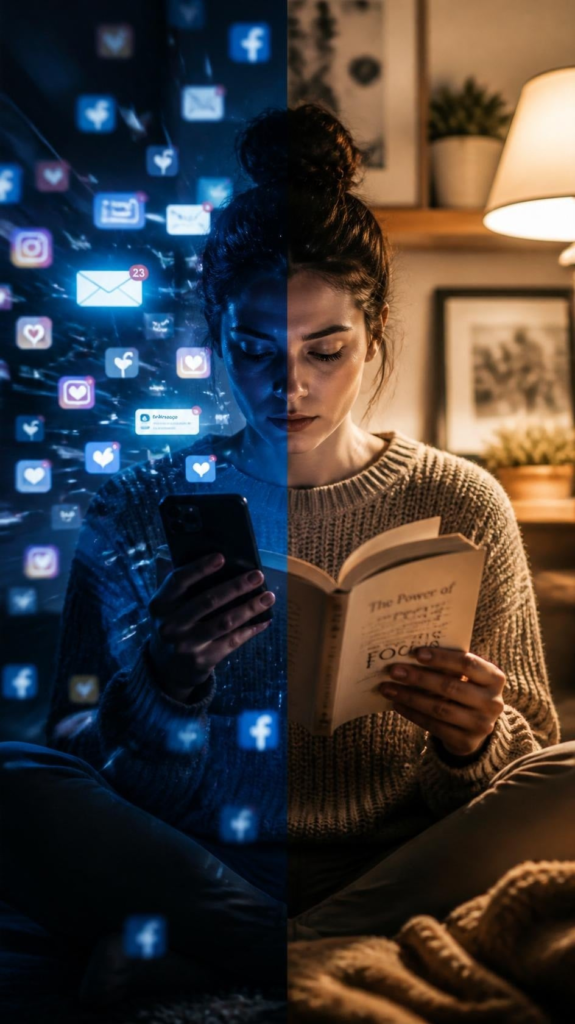
The timing isn’t a coincidence. Modern screen culture has subtly reshaped how attention operates. Between smartphone notifications, background updates, and endless scrolling, attention has become provisional—never fully given, always slightly alert to competing claims.
Even when readers pick up a book, that background hum of digital distraction tends to linger. A lot of readers began to feel like they were consuming books the way they consume everything else online—fast, fragmented, and only half-present.
The physical book revival tells the same story from a different angle. After years of reading happening primarily through screens, a meaningful number of readers are choosing print specifically because it offers a break from digital overload—something to hold, something with physical weight, and most importantly, something that isn’t also a notification machine.
This Isn’t New to Slow Living
If any of this sounds familiar, it should. The idea that quality and presence matter more than speed is the exact same philosophy behind slow mornings and gentle productivity, just applied to a bookshelf instead of a to-do list.
Reading has always been one of the most natural entry points into a slower lifestyle. It’s an activity that naturally resists multitasking—or at least it used to, before “finishing” a book quietly became its own kind of status achievement to broadcast on social media. What this slow reading trend gets right is refocusing on the actual experience of reading rather than the raw count of books completed.
You don’t need the audiobook-and-physical-copy method specifically to benefit from this shift. The underlying idea—giving a book your full attention instead of your divided attention—works with any format. What matters is the intention behind it: choosing presence over pace, the same way you might choose a slow, unhurried morning over a rushed one.
Bringing This Into Your Own Reading Life
If you want to borrow the spirit of the slow reading trend without following it to the letter, consider a few gentle shifts:
- Choose one book to read without splitting your attention: No phone within reach, no second screen—just the story and your full focus for however long you can manage. Notice how different that feels from your usual reading sessions.
- Try the combined immersive method: If your library card gives you access to audiobooks, test out the dual-format approach on a dense or challenging book you’ve been meaning to read but haven’t quite been able to focus on.
- Return to print: Consider returning to a physical copy of something you’d normally read on a screen. The tactile shift alone tends to slow people down without them even trying.
- Create a reading ritual: Pair your reading time with a small marker—a warm cup of tea, a specific lamp turned on at dusk, or ten minutes of reading before opening any digital devices
A Trend Worth Keeping
Most reading trends fade within a single season. This one might be different—not because the method itself is revolutionary, but because it’s pointing at something deeply human: a lot of us miss the feeling of actually being inside a book, rather than rushing through it just to say we finished.
The slow reading trend isn’t just a temporary fad. It’s simply reading the way it was always meant to feel, before speed became the primary metric we measured it by.
Discussion Question:
Do you read to finish, or do you read to be present in the story? Has that balance changed for you recently? Share your thoughts in the comments below.
Continue the Journey
- Reading Is a Lifestyle: Explore what it means to build reading into your everyday rhythm, not just your free time.
- Books & Peaceful Living: How reading naturally supports a slower, more intentional life.
- Cozy Finds for Book Lovers: The essentials that make slowing down with a book even more inviting.