
“A quiet hobby gives your hands something to do while your mind remembers how to wander.”
There is a particular kind of tiredness that does not come from doing too much, but from taking in too much.
Too many updates. Too many short videos. Too many open tabs and unfinished thoughts. Even our pauses can become crowded when every spare minute is filled with something to watch, read, answer, or refresh.
Slow hobbies offer another way to spend that time.
They invite us to make something, tend something, notice something, or simply stay with one activity long enough for the mind to settle. A few rows of knitting, a page in a journal, bread rising on the counter, or a quiet hour in the garden may not look especially productive. Yet these small practices can bring rhythm and texture back to days that have begun to feel overly digital.
The purpose is not to master a new skill as quickly as possible. It is to enjoy having something in your life that does not need to be optimized.
What Are Slow Hobbies?
Slow hobbies are activities enjoyed for their process rather than their speed, visibility, or outcome.
They are usually tactile, focused, and easy to return to over time. Many can be practiced without a screen and without turning the experience into content for other people.
Examples include:
- Reading.
- Gardening.
- Knitting or crochet.
- Embroidery.
- Journaling.
- Sketching.
- Baking bread.
- Doing puzzles.
- Birdwatching.
- Flower arranging.
- Pottery.
- Calligraphy.
- Letter writing.
- Repairing or mending clothing.
The activity itself does not have to be old-fashioned. What makes a hobby slow is the way you approach it.
You allow yourself to be a beginner. You resist the pressure to monetize it. You do not measure every session by progress. You return because the practice feels grounding, interesting, or quietly enjoyable.
This is slow living in one of its most accessible forms: choosing to spend part of your free time creating or noticing instead of consuming.
Why Slow Hobbies Are Returning
For years, convenience has moved much of daily life onto a screen. We work online, shop online, socialize online, and often look for entertainment in the same place.
The recent return to knitting, needlepoint, pottery, gardening, birdwatching, and other traditional activities reflects a desire for something more tangible. An Associated Press report on the revival of analog hobbies found that many younger people are embracing these practices as ways to unplug, create with their hands, and find community away from constant digital stimulation.
Their appeal is easy to understand.
A physical hobby has edges. A puzzle can remain on the table. A book has a final page. A garden changes gradually. A piece of embroidery grows one small section at a time.
Unlike an endless feed, these activities give our attention somewhere to rest.
The value of having a hobby also appears across cultures. A longitudinal study published in Nature Medicine examined adults aged 65 and older in 16 countries and found that hobby engagement was associated with greater happiness, life satisfaction, and self-reported health, as well as fewer depressive symptoms.
Although the study focused on older adults, it offers a meaningful reminder that leisure can support well-being throughout a slower life.
If you are beginning to reconsider how technology occupies your day, start with Digital Slow Living. Slow hobbies become especially helpful when they replace a familiar scrolling habit with something you genuinely want to return to.
Choose Process Over Performance
The quickest way to make a peaceful hobby feel like work is to demand that you become good at it immediately.
Modern hobbies are often presented through polished final results: the perfect loaf, the beautiful journal page, the carefully styled reading corner, or the sweater without a visible mistake.
What we do not see are the uneven stitches, failed recipes, crossed-out lines, and long stretches of ordinary practice.
A slow hobby makes room for all of them.
Creative activity does not need to be exceptional to hold value. A meta-analysis of creativity and well-being, covering 26 studies and more than 8,000 participants, found a positive relationship between creativity and well-being, particularly when creativity was measured through actual activities and behavior.
That does not mean every hobby must become a wellness assignment. It simply reminds us that everyday creativity can matter even when the result is imperfect.
Choose curiosity over performance:
- Learn one stitch instead of planning an entire blanket.
- Sketch one object rather than trying to create finished artwork.
- Grow one herb before designing a garden.
- Bake one familiar recipe until the process feels natural.
- Read for pleasure without setting a yearly target.
The hobby should feel like a place to return to, not another standard to meet.
Reading: The Simplest Slow Hobby
Reading may be the easiest slow hobby to begin because it requires very little preparation.
A physical book offers a different kind of attention from the fragmented rhythm of online reading. It asks us to follow one voice, one story, or one idea without constantly deciding what to open next.
You do not need to read challenging books or finish a certain number each month. Keep a novel beside your bed, carry a paperback in your bag, or read a few pages while your coffee cools.
The practice becomes even more inviting when the environment supports it. A comfortable chair, a warm lamp, and a place to leave your current book can transform reading from something you hope to do into something that naturally belongs to your day.
For inspiration, explore Books and Peaceful Living or create your own evening ritual with Quiet Reading Nights.
Handwork: Knitting, Crochet, Embroidery, and Mending
Handwork gives the mind a gentle point of focus.
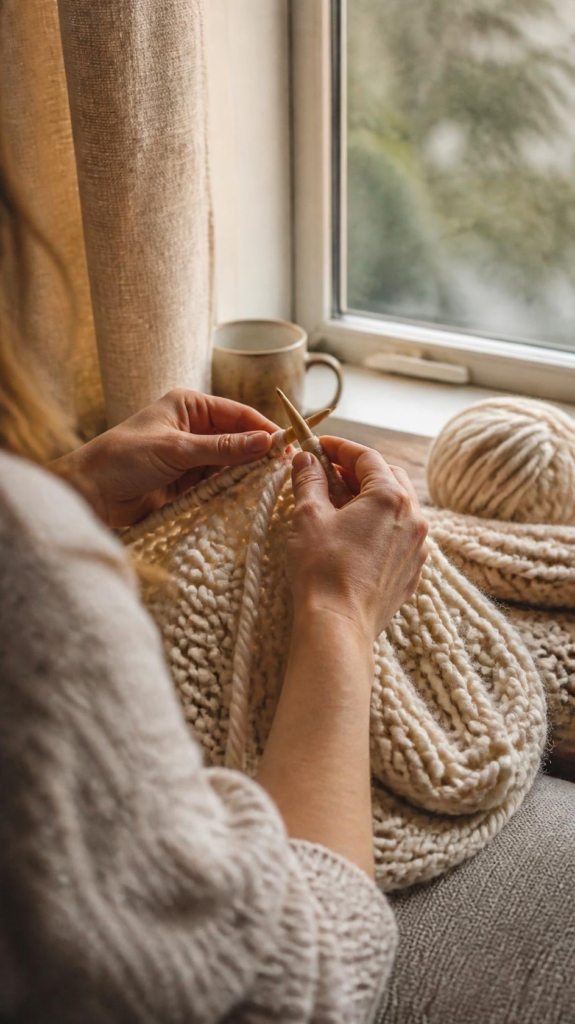
The repeated movement of yarn, thread, or fabric creates a natural rhythm. Progress is visible but unhurried. You can stop after ten minutes and return later without losing the experience.
Knitting and crochet are comforting choices for evenings, especially when you want to keep your hands occupied without reaching for your phone.
Embroidery is portable and can begin with a very small design. Mending turns an ordinary repair into a creative practice while helping familiar clothes last longer.
Start with one simple project:
- A knitted scarf.
- A crochet square.
- A small embroidered flower.
- A repaired seam.
- A visible patch on worn denim.
Do not begin by purchasing every possible supply. One set of needles, a little yarn, or a basic sewing kit is enough to discover whether you enjoy the process.
The quiet satisfaction comes from watching something take shape slowly in your hands
Journaling and Letter Writing
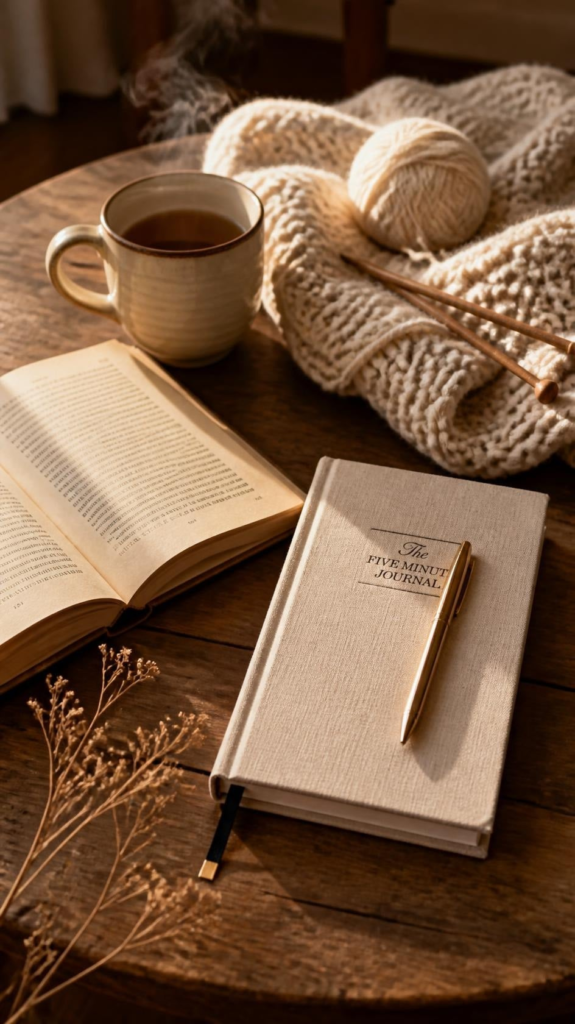
Writing by hand slows thought down just enough for us to hear it more clearly.
A journal does not need to contain profound reflections. It can hold observations from the day, a short list of things you noticed, a recipe you want to remember, pressed leaves, favorite sentences, or a few lines about the weather.
You might try:
- A one-page morning journal.
- A reading notebook.
- A seasonal journal.
- A commonplace book for quotes and ideas.
- A small record of ordinary moments.
- Handwritten letters or postcards.
Letter writing adds another layer to the practice. It asks us to think about one person without the interruptions of a message thread.
The result is both private and tangible: something written slowly, carried through the world, and held by someone else.
If a blank page feels intimidating, begin with one sentence:
What felt meaningful today?
That is enough.
Gardening and Caring for Something Living
Gardening naturally resists urgency.
Seeds have their own timing. Leaves respond to light, water, weather, and season rather than our schedules. Even a few herbs on a windowsill can teach the pleasure of paying attention to gradual change.
Research offers another reason this hobby continues to feel restorative. A 2024 umbrella review and meta-analysis published in Systematic Reviews found that gardening activities had an overall positive association with well-being, quality of life, and general health, while also noting differences among the studies reviewed.
You do not need a large garden to begin.
Try one of these:
- Grow basil or mint near a sunny window.
- Tend a few balcony plants.
- Propagate a cutting in water.
- Refresh the soil of a neglected houseplant.
- Grow flowers in one container.
- Visit a community garden.
- Keep a small record of what blooms each month.
Gardening makes time visible. It reminds us that care often happens through small, repeated actions rather than dramatic transformation.
Baking and Cooking Without Rushing
Cooking becomes a slow hobby when it is separated from the pressure of simply getting food on the table.
Choose something you are curious to make. Bread, soup, pasta, preserves, pie, or a familiar family recipe can become a weekend ritual rather than another daily obligation.
The pleasure is sensory:
- Flour on the counter.
- Vegetables being chopped.
- Dough changing beneath your hands.
- Herbs releasing their scent.
- A kitchen warming as something bakes.
Not every attempt will be beautiful. Some loaves will be too dense, and some recipes will not deserve a second try.
The point is not perfection. It is the experience of making something real and then sharing it.
If the kitchen feels overly busy, begin by creating a calmer atmosphere rather than buying new equipment. Clear one section of the counter, put on music, and give yourself enough time to enjoy the process.
Quiet Hobbies for People Who Do Not Feel Creative
You do not need to consider yourself artistic to have a slow hobby.
Many peaceful activities are based on attention, curiosity, or gentle problem-solving rather than artistic skill.
Consider:
- Jigsaw puzzles.
- Crosswords or logic puzzles.
- Birdwatching.
- Nature walks.
- Collecting leaves or pressed flowers.
- Learning to identify local plants.
- Listening to a full album.
- Building models.
- Caring for houseplants.
- Visiting libraries or secondhand bookshops.
- Keeping a list of seasonal observations.
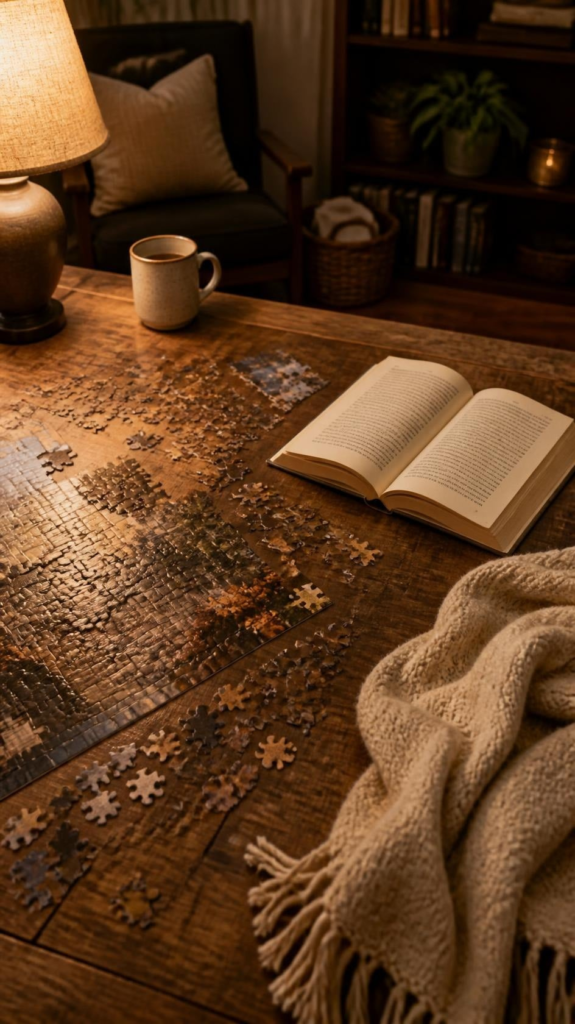
Birdwatching can begin by noticing what visits your window or neighborhood. A puzzle can stay open on a table for several days. A nature walk does not need a destination or fitness goal.

The best slow hobby is not necessarily the most impressive one. It is the activity that helps you forget to check the time.
Create a Place for Your Hobby
Hobbies are easier to continue when the materials are visible and ready.
If every session begins by searching through drawers, moving furniture, or setting up an elaborate workspace, the phone will remain the more convenient choice.
Create a simple home for the activity:
- A basket beside the sofa for yarn and needles.
- A tray with a journal, pens, and scissors.
- A puzzle table that can remain undisturbed.
- A small gardening shelf.
- A book placed beside your favorite chair.
- A portable box for watercolor supplies.
The space does not need to become a dedicated craft room. A single basket or corner is enough.
This follows the same principle explored in Warm Minimalism: home can remain calm while still showing signs of the life being lived inside it.
Let the materials serve as a quiet invitation.
Begin Without Turning the Hobby Into Consumption
Starting something new can quickly become an excuse to shop.
We research the best notebooks, the perfect needles, the complete watercolor set, or every gardening tool before discovering whether we enjoy the activity itself.
Begin with what you already have whenever possible.
Borrow a library book. Use an unfinished notebook. Ask a friend for leftover yarn. Start with a pencil and ordinary paper. Plant seeds from herbs you already cook with. Try a puzzle from a secondhand shop.
Give the hobby time to reveal what you actually need.
This keeps the beginning light and protects the practice from becoming another project built around comparison or consumption.
Build a Gentle Weekly Rhythm
A slow hobby does not need to happen every day.
Choose one small pocket of time that already fits your life:
- Twenty minutes after dinner.
- A quiet Saturday morning.
- One screen-free evening each week.
- The time spent waiting during an appointment.
- Sunday afternoon at the kitchen table.
Keep the rhythm flexible.
Some weeks you may spend hours absorbed in the activity. Other weeks you may only knit two rows, read three pages, or water the plants.
Both count.
The value of a slow hobby is not found in maintaining a perfect streak. It is found in having something peaceful to return to.
This is also why hobbies pair naturally with the ideas in Simple Living Moments. A meaningful life is often built from small experiences that do not appear remarkable from the outside.
A Hobby Does Not Need to Become More
Not every skill needs to become a business.
Not every finished object needs to be posted online. Not every book needs a review. Not every walk needs to be tracked. Not every quiet interest needs to develop into expertise.
Some things can remain beautifully unnecessary.
A slow hobby creates a protected part of life where enjoyment is enough. It lets us make mistakes without an audience, follow curiosity without a strategy, and spend time without trying to turn it into a measurable return.
In a culture that often asks what our time produces, choosing a hobby simply because we love it can feel quietly radical.
Perhaps the most valuable result is not the scarf, the loaf, the journal, or the garden.
Perhaps it is the hour in which you were fully there.
Frequently Asked Questions About Slow Hobbies
What is a slow hobby?
A slow hobby is an activity enjoyed for its process rather than speed or productivity. Slow hobbies are often tactile, focused, and screen-free, helping you spend time with greater presence.
What are the best hobbies for reducing screen time?
Reading, knitting, crochet, gardening, journaling, puzzles, baking, drawing, embroidery, birdwatching, and letter writing are helpful because they provide a specific activity to choose instead of scrolling.
Do slow hobbies need to be completely screen-free?
No. Technology can help you learn a technique, find a pattern, or connect with a group. The goal is to let the screen support the hobby rather than become the hobby itself.
What is the easiest slow hobby to start?
Reading, journaling, walking, and doing puzzles require little preparation. Begin with an activity that uses something you already own and can practice for ten or twenty minutes.
How do I choose the right slow hobby?
Consider whether you want to create, move, learn, observe, or care for something. Then try one activity on a small scale before buying many materials.
The right hobby is one you enjoy returning to, even when you are not especially good at it yet.
Can a slow hobby still be productive?
It may produce something useful, but productivity does not need to be its purpose.
A finished scarf or a homegrown herb is welcome; the deeper value is often the attention, pleasure, and rest found in the process.
Continue de Journey
- Digital Slow Living: A Calmer Relationship With Technology — Discover gentle ways to use technology with greater intention and create more room for life away from the screen.
- Simple Living Moments: Finding Joy in Ordinary Days — Explore how quiet rituals and ordinary experiences can bring more presence and meaning into everyday life.
- Books and Peaceful Living — Learn how reading can become part of a slower, calmer, and more intentional lifestyle.
- Quiet Reading Nights — Create a comforting evening ritual built around warm light, peaceful surroundings, and a book you enjoy.
- Warm Minimalism: How to Create a Calm Home That Still Feels Cozy — Shape a calm and welcoming home that leaves space for the hobbies, objects, and rituals that matter to you.